
How Learning to Catch Winter Bait Led to Trophy Blue Catfish PBs on the James River
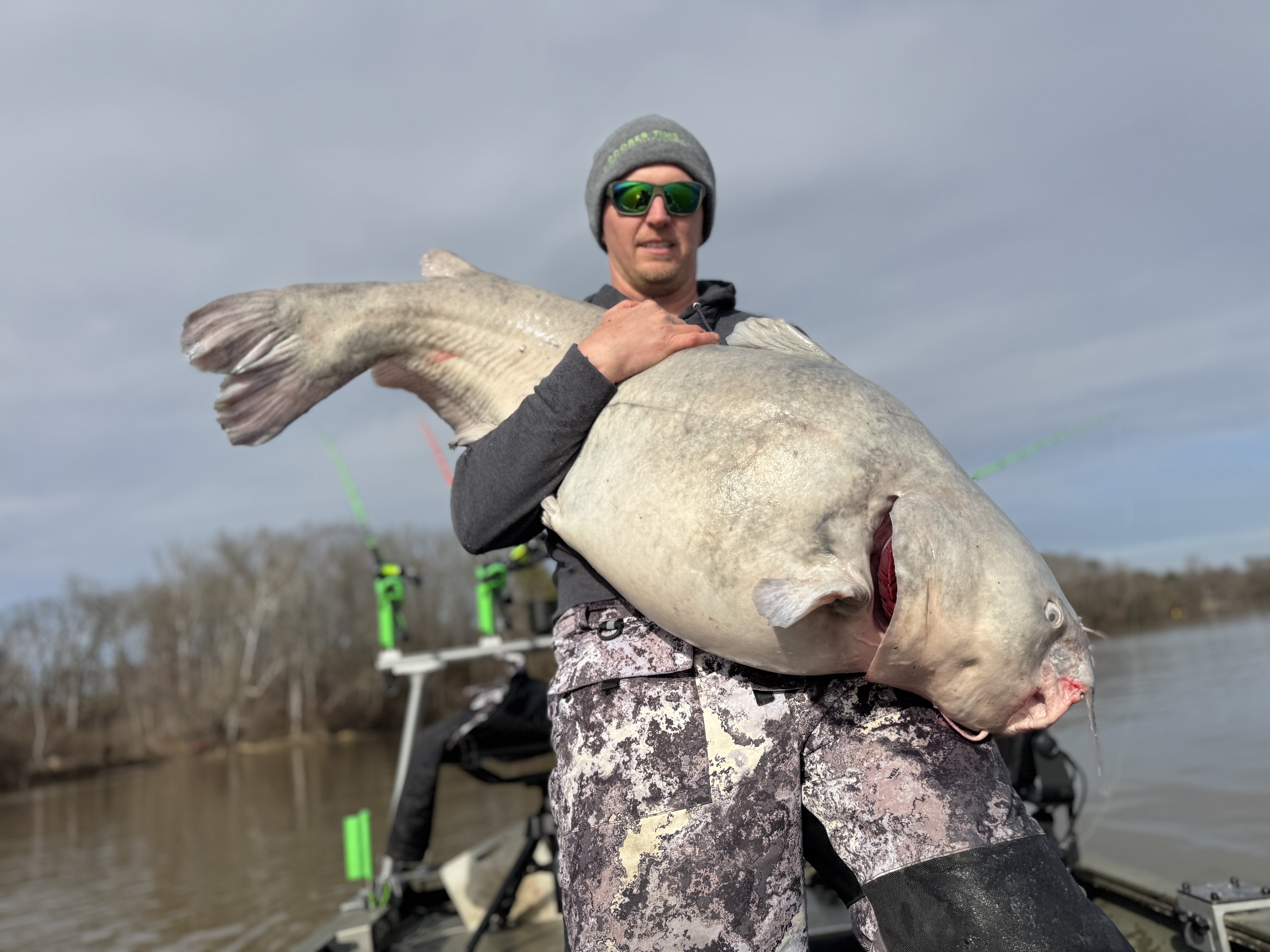
Dakota and Preston recently booked a trip with Goober Time Guide Service on the James River. Their primary goal wasn't just to catch fish, but to learn how to consistently locate and catch the bait fish required for trophy blue catfishing. It was a fantastic day of teaching, adapting to the winter water conditions, and ultimately putting a trophy fish in the boat.
Utilizing Marine Electronics to Locate Winter Bait
We started the trip by focusing on the sonar. Using the sidescan, downscan, and 2D imaging on our Garmin chartplotter, we scanned the depths for large concentrations of bait fish.
After locating a significant school of gizzard shad in 25 to 30 feet of water, we deployed a sinking gill net. During the winter months, bait fish tend to be sluggish and don't move around much. Knowing this, we used a classic tactic: we turned up the stereo, used the outboard motor to create a commotion, and stomped on the floor to stir the fish up. Despite dropping the net right into a pocket of fish, our first set only yielded a single gizzard shad.

We made a slight adjustment, moving to an area with a thicker cluster of shad. This time, we let the net soak a bit longer and threw the cast net a few times while we waited. The combination of the two nets paid off, and we successfully secured enough fresh bait to start hunting for trophy catfish.

The Hunt: Reading the River and Adapting Tactics
Our search for big blue cats started on a transition ledge, but the sonar showed zero fish activity. We moved to some deep, underwater structure and marked a few fish tucked tightly into the rocks. We set up and tossed out fresh, cut gizzard shad. After 30 minutes without a single tap, we knew it was time to keep moving.

We scanned a series of deep holes, structures, and wing dams, but the graph remained empty. Shifting our strategy, we began pulling planer boards through moderate-depth water. Over the course of an hour, we marked several nice fish buried in the mud, but none were willing to bite.
Having burned through a good portion of the morning, we made a strategic move toward warmer water. This gave me another great opportunity to show Dakota and Preston some reliable winter bait spots along the way.
Finding Active Fish in Warmer Waters
This new area was the polar opposite of what we had seen all morning—the water was full of life. We used our shallow water poles to lock the boat in place and deployed the rods. The baits immediately started getting taps, and within 20 minutes, we hooked our first fish of the day: a healthy 5-to-7-pound blue catfish that we quickly released.

A few minutes later, we landed another fish of similar size. We waited about 20 more minutes hoping a larger fish was in the area, but the big bite never came. While waiting, we tossed the cast net a few more times, loading the cooler with about a dozen gizzard shad for the guys to freeze and take home for their own future trips.
The Climax: A Chaotic Fight and a New Personal Best
As the day warmed up and the sun came out, we knew it was time to push shallow. With about 90 minutes left in the trip, we worked our way back upriver, stopping to scan a section of the river heavily populated with wing dams.
We fan-cast eight rods loaded with fresh bait. Suddenly, a rod cast right at the base of a wing dam rocketed toward shallower water. We instantly knew it was a heavy fish. Unfortunately, the fish wrapped the line around some pilings, forcing us to pull in all the other rods and chase it down.
What followed was a chaotic five minutes of maneuvering. We managed to untangle the line, only to find a very angry trophy catfish on the other end. The fish made a hard run for deep water, diving straight under the boat. Knowing our line was likely compromised from the pilings, we had to work smoothly as a team to keep the fish under control. We let it tire out, gently guided it to the surface, and slipped the net under it.
All the effort was worth it. We hoisted aboard a 34-pound blue catfish—a brand new personal best for the boat! Welcome to the trophy club, guys.

Closing Out a Great Day on the James River
We set the rods back out, and within 10 minutes, another rod bent over. This fish put up a solid fight but was far less troublesome than the last, weighing in between 15 and 20 pounds.

Because we had caused quite a commotion during the catch, we made one final move a couple of hundred yards to another wing dam. We gave it 20 minutes, but after only a few light taps and no commitments, we decided to call it a day.
Thank you, Dakota and Preston, for choosing Goober Time Guide Service for your Central Virginia fishing adventure. We love helping anglers land their personal bests and teaching them the intricacies of the river. We can't wait to get you back on the water!

Goober Time Guide Service offers premier guided fishing experiences throughout the James River and key bodies of water across Central Virginia. We specialize in multi-species excursions, targeting trophy Blue Catfish, Flathead Catfish, Smallmouth Bass, Striped Bass, and Crappie.
Our versatile fleet includes a fully-equipped main vessel for full-group charters, as well as specialized kayaks, paddleboards, and whitewater rafts to access remote waters and low-pressure fisheries. Furthermore, we offer exclusive light-lining charter trips for elite anglers seeking the ultimate technical challenge and potential record-breaking catches.
Contact us to consult on your group’s goals, and we will expertly design a tailored fishing adventure to exceed your expectations.
Captain Dan Szajta
USCG Master Charter Captain
804-592-0456
*Contents of this article may not be reproduced without the prior consent of Goober Time Guide Service, LLC.


Comments