
A Guide to Understanding Blue Catfish Behavior: Seasonal Patterns & Tactics
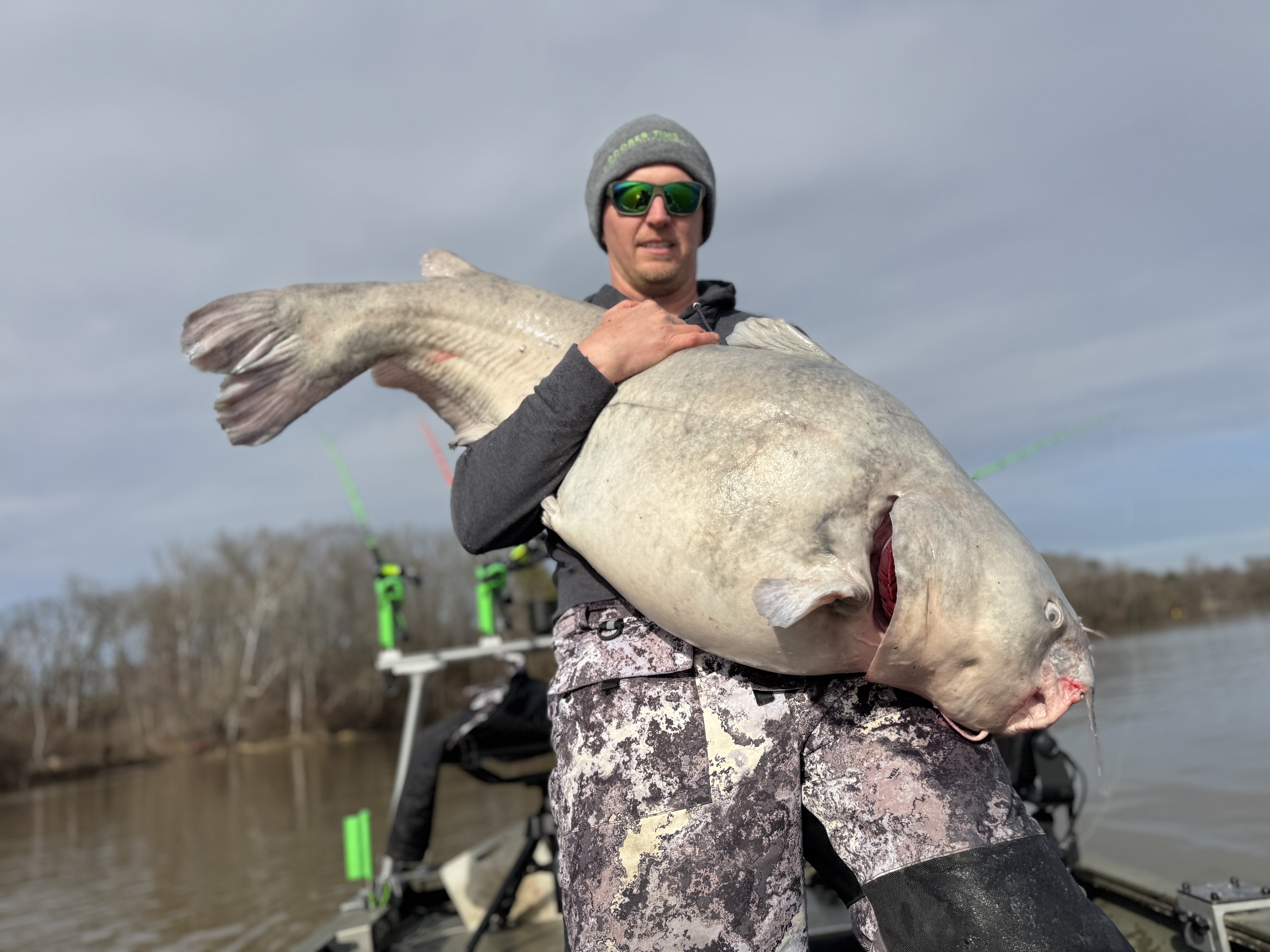
Blue catfish don’t roam at random. They follow food, current, temperature, light, oxygen, and cover. Read those cues well, and the river starts to feel less like guesswork.
Blue catfish, Ictalurus furcatus, are built for big water. They thrive in tidal rivers, reservoirs, tailwaters, and major river systems across much of the U.S. They’ll eat shad, herring, skipjack, mussels, crayfish, freshwater drum, and about any easy protein source they can pin down.
The key is timing. A pattern that happens in March on a southern tidal river may not show up until late May in a northern reservoir. Calendar dates help less than water temperature, current, and forage movement.

Water temperature sets the seasonal schedule
Water temperature drives blue catfish behavior more than any calendar month. These fish are cold-blooded, so their metabolism, digestion, and feeding windows rise and fall with the water around them.
That doesn’t mean every fish in a lake moves at once. Deep reservoirs warm slowly. Shallow tidal rivers can change fast. A muddy flat may be 5°F warmer than the main channel on a sunny afternoon. That small difference can pull baitfish shallow, and blue cats often follow.
Use these benchmarks as a starting point.
Water temperature | Typical behavior phase | Target depths | Primary structure |
Under 50°F | Winter basin consolidation | 30 to 60+ ft | Scour holes, channel bends, deep basins |
50°F to 70°F | Pre-spawn feed | 3 to 18 ft | Warming mud flats, shallow creek mouths |
70°F to 82°F | Spawn and post-spawn recovery | Variable | Rock ledges, riprap, heavy timber, undercut banks |
Warm summer flow | Summer feeding patterns | Mid-depth to deep | Main-channel ledges, wing dams, tailwaters |
Cooling fall flow | Secondary fall feeding peak | Multiple depths | Channel edges, secondary points, flats |
These are not hard borders. They’re behavior windows. A cold front, rising river, heavy generation schedule, or shad movement can bend the pattern for a day or two.
Winter fish consolidate in deep basins
When water drops below 50°F, blue cats often gather in predictable wintering areas. Think deep channel bends, outside turns, old river channels, scour holes below current, and basin edges near bait.
They don’t stop feeding, but they usually feed in shorter windows. Digestion slows in cold water, so they can eat one good meal and stay inactive longer than they would in spring.
Good winter areas usually share three traits:
Depth close to travel lanes
Deep holes near the main channel let fish move without burning energy.
Reduced current
Blue cats may sit just outside the heaviest push, especially behind bends, humps, or ledges.
Forage nearby
If sonar shows balls of shad stacked in 35 to 50 ft, that’s often better than perfect-looking structure with no bait.
Winter bites can be subtle. A big blue may load the rod slowly instead of hammering it. Fresh cut bait shines because scent matters when fish are less willing to chase.
Spring puts blue cats on the feed
Once water climbs into the 50°F to 70°F range, the fish become more active. This is one of the best windows of the year because blues feed hard before spawning.
The best spots are often shallower than many anglers expect. Warming mud flats, shallow creek arms, inside bends, and feeder creek mouths can all load up with bait. Mud absorbs heat faster than rock or deep open water. That warmth draws in shad, carp, and other forage.
A 6 ft flat beside a 20 ft channel can be better than miles of featureless deep water. The nearby drop gives big fish security. The flat gives them food.
Wind matters in spring too. A steady wind pushing into a muddy bank can stack plankton, baitfish, and predators. If that bank is near a creek mouth or channel swing, it deserves serious time.
This is where blue catfish behavior gets easier to predict. Find warming water plus forage plus nearby depth. That simple triangle explains a lot of big spring fish.

Spawning changes the whole game
Blue catfish usually spawn when water reaches roughly 70°F to 82°F, though local timing varies. They are cavity-oriented spawners. That means they use protected spaces where eggs can be guarded.
Likely spawning cover includes:
Riprap banks
Rock ledges
Undercut banks
Hollow logs
Heavy timber
Concrete walls
Old bridge rubble
Bank holes in tidal systems
During the spawn, fishing can feel inconsistent. Some larger fish lock onto cover and stop roaming as much. Others feed before or after the main spawning push. Not every fish spawns the same week, which helps keep some fish catchable.
Post-spawn fish can be sluggish for a short stretch. After recovery, they begin sliding back toward feeding routes. In rivers, current edges and nearby deeper water become important again. In reservoirs, look for structure close to creek channels, submerged roadbeds, points, and bait schools.
Summer fish need current, oxygen, and easy meals
Summer is not just “deep water season.” It’s current season.
Warm water raises a fish’s metabolism, but it also holds less dissolved oxygen than cool water. Current helps by bringing oxygen and food. That’s why tailwaters, wing dams, outside bends, ledge edges, and channel constrictions can be so good.
Blue cats in summer often set up where current delivers food without forcing them to fight the full flow. They may hold:
Behind a wing dam
At the base of a ledge
On the downstream side of a hump
Along a current seam
Below a dam during generation
In a deep outside bend with bait overhead
Reservoir fish may relate more to thermoclines. A thermocline is a layer where water temperature changes quickly with depth. Below it, oxygen can get low in some lakes. If fish and bait are showing above a certain depth on sonar, don’t waste time fishing far below them.
Fresh bait matters in summer. Warm water spreads scent fast, but it also breaks bait down fast. Rotate baits often if they wash out.
Fall creates a second major feeding push
As summer heat fades and water cools, shad and other forage move. Blue cats follow. Fall can produce some of the most aggressive feeding of the year because fish are putting on weight before winter.
The trick is tracking transitions. Fish may use shallow flats during low light, then slide to channel edges after the sun gets high. In reservoirs, secondary points near creek channels are worth checking. On rivers, channel swings near flats can be money.
Cooling water spreads fish out at first. Later, as temperatures keep dropping, they tighten back toward winter structure. That shift can happen fast after several cold nights.
A strong fall day often has this pattern:
Fish shallow feeding flats early.
Move to nearby channel edges midmorning.
Check deeper bends or ledges in bright sun.
Return shallow if wind, clouds, or bait activity picks up.
Daily rhythms follow light and food
Season matters, but the daily rhythm matters just as much. Blue cats can feed any time, including high noon, but light level often changes where they feel comfortable hunting.
Low light gives baitfish less visibility and lets big blues move shallower. Dawn, dusk, night, and cloudy periods often open up flats, bank edges, and shallow bars.
Bright sun tends to push fish tighter to structure or deeper edges, especially in clear water. In muddy water, that light penalty is weaker. A shallow mud flat can still produce at midday if bait is present.
Night fishing is not magic, but it does change the map. Fish that hold in 25 ft by day may slide onto a 5 ft shelf after dark. In tidal rivers, that night movement may line up more with tide and current than clock time.
Barometric pressure gets a lot of talk. Fish don’t read numbers, but pressure changes often come with weather changes that affect feeding. Falling pressure before a front can trigger movement. High, bright, post-front conditions often make fish tighter to cover and less willing to chase.

Habitat secrets are really about edges
The best blue catfish spots usually have an edge. That edge can be depth, current, cover, temperature, or bait.
A flat with no nearby drop may hold fish briefly. A flat beside a creek channel can hold fish every day. A deep hole with no food may look great on a map but fish poorly. A smaller hole below a current seam with shad flickering on top can be loaded.
Focus on these high-value edges:
Channel bends
Outside bends create depth, current breaks, and feeding lanes.
Ledges
Blues can sit below the lip and rise to feed with little effort.
Creek mouths
These funnel bait, especially during spring and fall.
Scour holes
Holes below bridges, dams, and hard current breaks give fish depth and rest.
Riprap and rock
Rock holds cavities, shade, crayfish, and baitfish.
Timber and logjams
Wood breaks current and creates ambush cover.
Tidal seams
In tidal rivers, moving water positions fish. Slack tide often slows the bite.
The best anglers don’t just mark structure. They ask why a fish would be there right now. If the spot offers food delivery, comfort, and a safe travel route, it’s worth fishing.
Current tells blue cats where to point their nose
In rivers, current is the dinner bell. Blue cats often face into the flow and let food come to them. They don’t need to sprint all day. They just need to hold where the river brings prey within striking range.
That’s why bait placement matters. If the fish are tucked behind a ledge, a bait placed too far downstream may never reach their scent lane. If they’re sitting on the soft edge of a seam, a bait thrown into the ripping main current may wash past them.
A good spread covers lanes, not random distances. Put one bait on the current seam, one on the softer inside edge, and one near the drop or cover. Let the fish show which lane they’re using.
In reservoirs without steady current, wind can create a smaller version of the same effect. Wind-blown points, flats, and banks can concentrate bait. Boat traffic can also create short feeding windows near riprap or marinas, where waves disorient small fish.
Forage decides whether structure matters
Blue cats are opportunistic predators, but they are not lazy scavengers only. They actively hunt live prey and also take dead or injured food when available. Their barbels and taste-sensitive skin help them detect food in low visibility, which is one reason they thrive in muddy water.
Shad are a major forage in many systems. So are skipjack herring in big rivers where they occur. In some reservoirs, blue cats also feed heavily on freshwater mussels, Asian clams, crayfish, and rough fish.
Match bait to local forage when legal and practical. Fresh cut shad is hard to beat in shad-based reservoirs. Skipjack is a classic big-river bait. In waters with lots of white perch, drum, or carp, fresh cut pieces can produce well.
The best bait is usually:
Fresh, not freezer-burned
Oily or bloody
Sized to the fish you want
Legal for that specific water
Changed before it loses scent
Big baits can catch big fish, but don’t ignore smaller chunks when water is cold or pressure is high.
Accelerated Learning: Making Adjustments on the Fly
While understanding the theory behind water temperatures, current seams, and tidal stages gives you a solid foundation, putting those variables together on live water takes time and practice. River conditions can change quickly—a sudden muddy swell, a shift in tidal flow, or a localized cold front can alter fish positioning in an instant.

One of the fastest ways to shorten the learning curve is to spend time on the water with a professional local guide. Booking a trip with a experienced service like Goober Time Guide Service on the James River lets you watch how real-time adjustments are made firsthand. From reading sonar reads on river ledges to shifting tactics as the tide turns, learning how to adapt on the fly with a guide gives you practical knowledge you can take back to your own boat.

Captain Dan Szajta is a USCG Master Captain and IGFA Captain who brings a unique, analytical edge to the waters of Central Virginia. When he isn’t guiding clients to "river monsters" on the James River, Dan serves as a high school math teacher—a background that fuels his precision-based approach to angling. By combining formal maritime expertise with a teacher’s knack for breaking down complex patterns, Dan specializes in breaking the code on trophy Blue Catfish, Flathead Catfish, and Smallmouth Bass for anglers of all skill levels.
Operating Goober Time Guide Service, Dan offers a versatile experience tailored to the water's demands. Whether you are hunting giants from his fully equipped main vessel or launching a kayak or raft to reach remote, low-pressure fisheries, his mission is to provide more than just a day on the water. Every trip is an opportunity to learn the "why" behind the bite, blending high-energy adventure with the technical insights of a true multi-species specialist.
Captain Dan Szajta
USCG Master Charter Captain
804-592-0456
*Contents of this article may not be reproduced without the prior consent of Goober Time Guide Service, LLC.


Comments